
Blog
What is an Equipment Appraisal?
An equipment appraisal is a USPAP-compliant, written opinion of machinery and equipment value used for financing, insurance, tax, and legal purposes. This guide covers what a compliant report must contain, how appraisers determine value, and the specific situations that require one.
An equipment appraisal is a written, independent opinion of the value of machinery, equipment, and other tangible business assets, developed by a qualified appraiser and documented in a report that follows recognized professional standards. Lenders, the IRS, courts, and insurers all lean on these reports when a dollar figure needs to hold up to outside scrutiny, not just sound reasonable in conversation. This guide covers what a compliant report has to contain, when you're required to get one, and how our equipment appraisal service arrives at a defensible number for machinery and equipment.
What is an Equipment Appraisal?
An equipment appraisal is a formal, written opinion of value for machinery, equipment, and other tangible personal property, developed and reported in accordance with the Uniform Standards of Professional Appraisal Practice (USPAP). It is distinct from a dealer quote or a listing price: it documents intended use, the value definition applied, the property inspected, and the reasoning behind the final number.
USPAP is the appraisal standard used across the United States, and equipment appraisals fall under its personal property provisions, developed and reported under USPAP Standards 7 and 8. USPAP is maintained by The Appraisal Foundation and revised on a two-year cycle, so an appraiser working today is following a slightly different rulebook than one working five years ago.
What separates an appraisal from an estimate is the process behind it. A qualified appraiser identifies the client and intended use, selects the correct definition of value, inspects and describes the equipment, researches the market, applies one or more valuation approaches, and signs a certification standing behind the conclusion. A verbal ballpark number from an equipment dealer skips nearly all of that, which is exactly why regulators and courts don't treat the two as interchangeable.
When Do You Need an Equipment Appraisal?
You need an equipment appraisal whenever a third party, a lender, the IRS, a court, or an insurer, requires a documented, defensible value rather than an internal estimate. The specific value premise changes depending on why the appraisal is being ordered, and choosing the wrong one can make an otherwise solid report useless for its purpose.
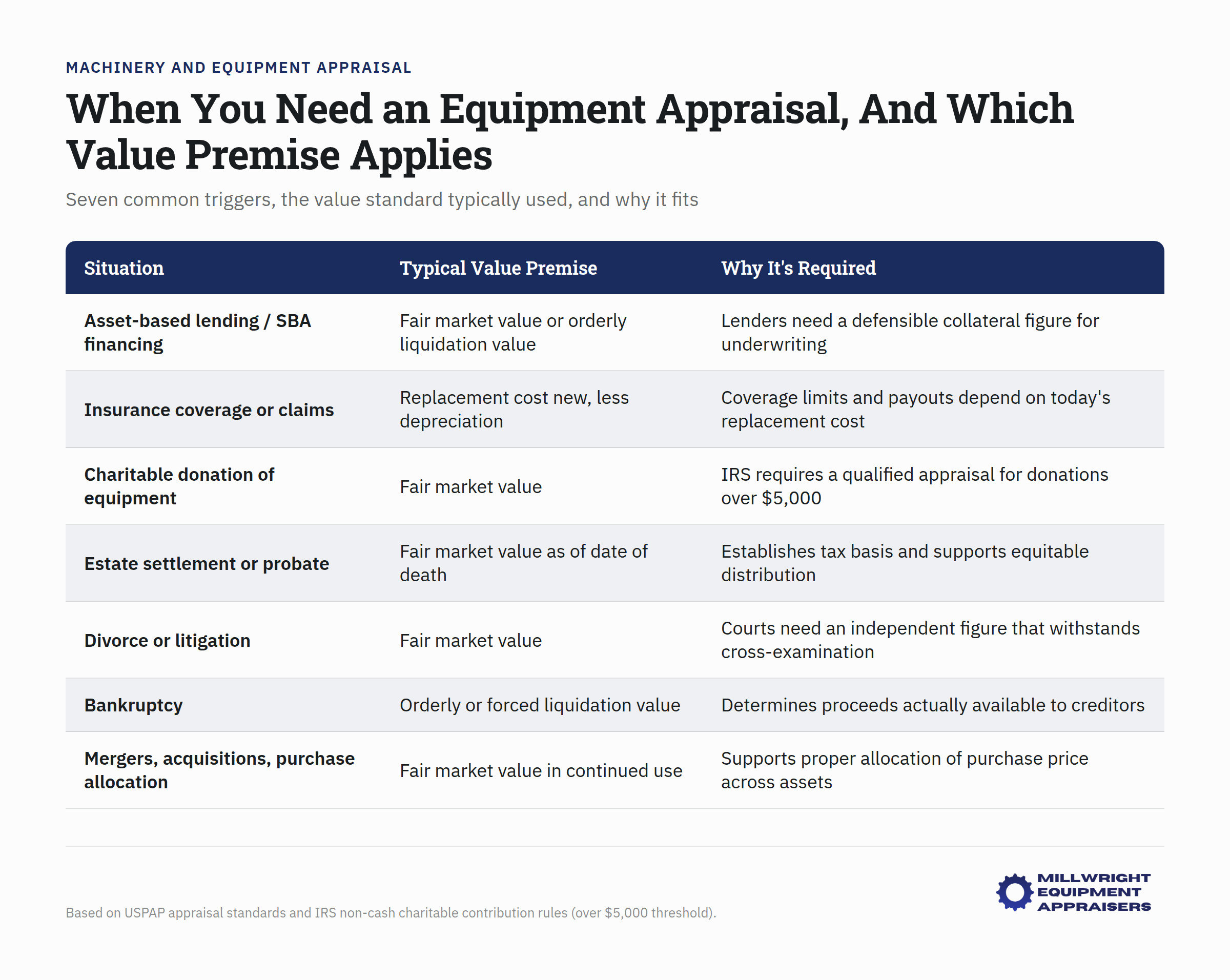
The table below maps common situations to the value premise typically applied and the reason that premise fits.
| Situation | Typical Value Premise | Why It's Required |
|---|---|---|
| Asset-based lending or SBA-backed financing | Fair market value or orderly liquidation value | Lenders need a defensible collateral figure that meets underwriting standards |
| Insurance coverage or claims | Replacement cost new, less depreciation | Coverage limits and claim payouts depend on what it costs to replace the equipment today |
| Charitable donation of equipment | Fair market value | The IRS requires a qualified appraisal for non-cash donations over a set dollar threshold |
| Estate settlement or probate | Fair market value as of the date of death | Establishes tax basis and supports equitable distribution among heirs |
| Divorce or litigation | Fair market value | Courts need an independent, unbiased figure that will hold up under cross-examination |
| Bankruptcy | Orderly or forced liquidation value | Determines what proceeds are actually available to creditors |
| Mergers, acquisitions, or purchase price allocation | Fair market value in continued use | Supports proper allocation of the purchase price across acquired assets |
Financing is one of the most common triggers. When equipment secures a loan, a lender or SBA-participating bank typically wants a USPAP-compliant appraisal rather than an internal estimate, because collateral decisions carry real underwriting risk.
Tax situations carry their own hard threshold. Under IRS rules, a non-cash charitable contribution over $5,000, including donated equipment, requires a qualified appraisal prepared by a qualified appraiser before the deduction can be claimed. The IRS publishes the specific form and instructions that spell out what the appraiser and the report both need to satisfy, and our equipment appraisal for charitable donation work is built around meeting that standard from the first inspection.
What's Inside a USPAP-Compliant Equipment Appraisal Report?
A USPAP-compliant report contains a defined set of elements under Standards 7 and 8: the development standard governs how the appraiser reaches a conclusion, and the reporting standard governs what the written document must disclose. Miss one of these elements and the report can be rejected outright by a lender's underwriting team or an IRS reviewer.
At minimum, a compliant report identifies:
- Client and intended users: who ordered the appraisal and who is authorized to rely on it
- Intended use: the specific purpose the report will serve (financing, insurance, tax, litigation, and so on)
- Type and definition of value used, and its source: fair market value, orderly liquidation value, or another premise, along with where that definition comes from
- Effective date and report date: the date the value opinion applies to versus the date the report was written
- Description of the equipment: make, model, serial number, age, condition, and quantity for each asset
- Scope of work: the extent of the inspection, research, and analysis actually performed
- Valuation approaches applied: which methods were used and why, along with a reconciliation into a single final opinion
- Disclosure of assumptions or hypothetical conditions: anything the appraiser assumed rather than verified directly
- Signed certification: the appraiser's statement affirming independence, competency, and compliance with USPAP
A report missing the scope of work section, for example, gives a reviewer no way to judge whether the appraiser actually inspected the equipment or just relied on a spreadsheet.
Watch out: A one-page letter stating a dollar figure with no methodology, no property description, and no certification is not a USPAP-compliant appraisal, no matter how confident it sounds. Lenders and the IRS can and do reject these.
How is Equipment Value Determined?
Equipment value depends first on which value premise applies, and second on which valuation approach the appraiser uses to get there. Getting the premise wrong produces a technically accurate number that answers the wrong question.
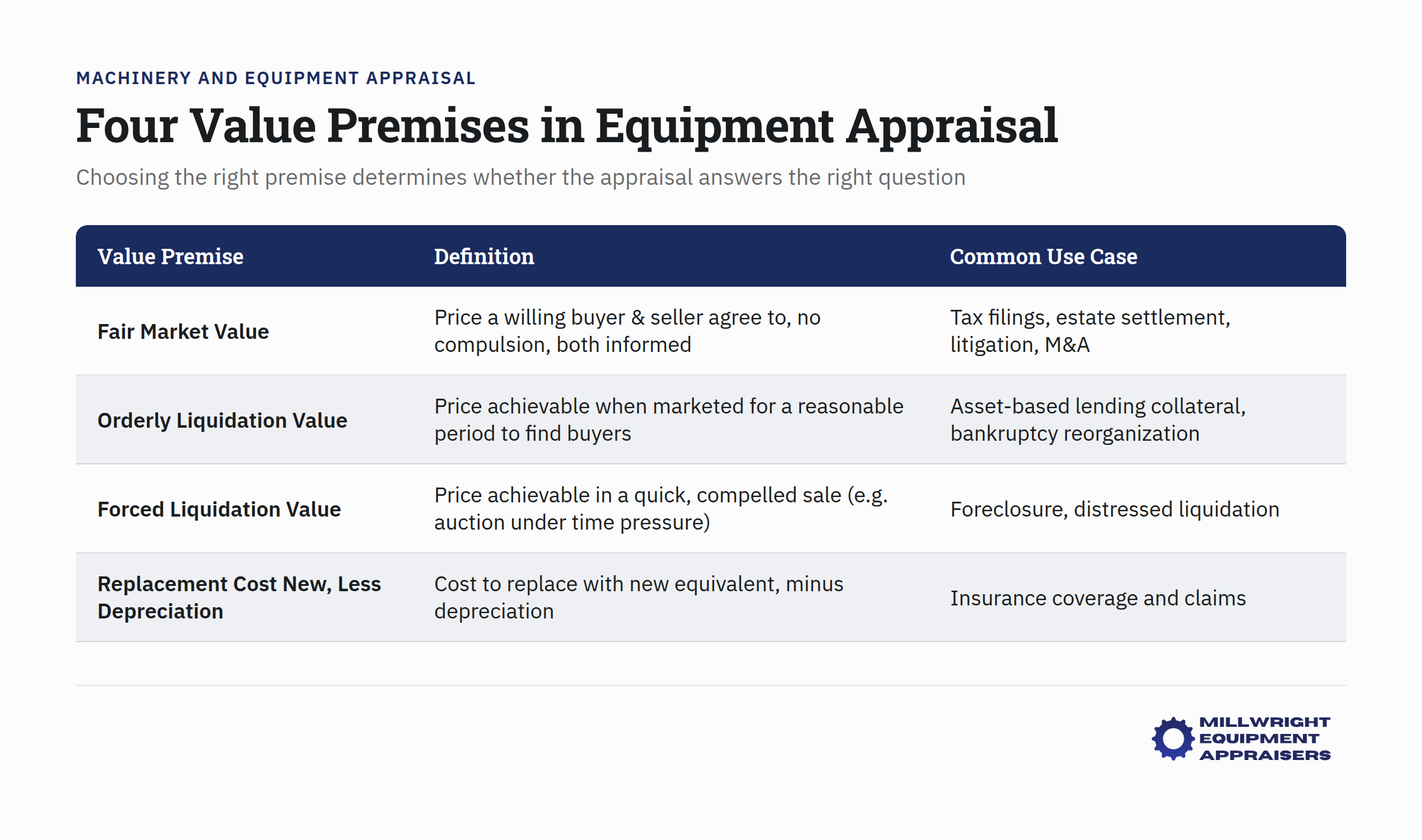
The table below contrasts the four value premises most commonly used in equipment appraisals.
| Value Premise | Definition | Common Use Case |
|---|---|---|
| Fair Market Value | The price a willing buyer and willing seller would agree to, with neither under compulsion and both reasonably informed | Tax filings, estate settlement, litigation, M&A |
| Orderly Liquidation Value | The price achievable when equipment is marketed for a reasonable period to find qualified buyers | Asset-based lending collateral, bankruptcy reorganization |
| Forced Liquidation Value | The price achievable in a quick, compelled sale, such as an auction under time pressure | Foreclosure, distressed liquidation |
| Replacement Cost New, Less Depreciation | The cost to replace the equipment with a new equivalent, minus physical, functional, and economic depreciation | Insurance coverage and claims |
Once the premise is set, USPAP directs appraisers to consider three approaches to value and reconcile them into a single conclusion:
- Cost approach: starts with the cost to reproduce or replace the equipment new, then deducts depreciation from age, wear, and obsolescence
- Sales comparison approach: looks at actual sales or listings of comparable equipment in the relevant market
- Income approach: estimates value based on the income the equipment generates or supports, used less often for equipment than for real estate or business valuation
Not every approach applies to every asset. A 3-year-old CNC machine with an active resale market might lean heavily on sales comparison, while a custom-built production line with no direct comparables might rely more on the cost approach. The appraiser's job is to weigh the approaches that produce credible, well-supported evidence for that specific piece of equipment, not to run all three mechanically and average the results.
Who Performs an Equipment Appraisal?
Equipment appraisals are performed by credentialed appraisers who work in accordance with USPAP and have the specific product knowledge to value the asset category in question. Credentials matter here because equipment valuation is a specialized skill: knowing how to value a fleet of forklifts is a different competency than valuing a bottling line or a CNC machine shop.
Our appraisers hold credentials from organizations such as the American Society of Appraisers (ASA), the Certified Appraisers Guild of America (CAGA), and the NEBB Institute's Certified Machinery and Equipment Appraiser (CMEA) designation. No single appraiser carries every credential on that list; assignments are matched to the appraiser whose background fits the equipment type and intended use of the report. What stays constant across every assignment is USPAP compliance: proper scope of work, an independent value opinion, and a signed certification the appraiser stands behind.
Pro tip: If a report is headed for an IRS filing, an SBA-backed loan, or a courtroom, ask upfront whether the appraiser's credentials and the report format match that specific use. A report built for insurance replacement cost won't automatically satisfy a lender asking for orderly liquidation value.
A Few Questions Worth Answering Directly
Does the $5,000 donation threshold apply per item or per tax year? It applies to similar items aggregated across the tax year, not just to a single donation. If you donate several pieces of equipment in the same general category and their combined claimed value exceeds $5,000, a qualified appraisal is required even if no single item crosses that line on its own.
Does an equipment appraisal expire? There's no fixed expiration date written into USPAP, but value opinions are tied to a specific effective date. Equipment depreciates, markets shift, and a report that's several years old no longer reflects current condition or market activity, so most lenders, insurers, and the IRS expect a reasonably current report for the transaction at hand.
Machinery and equipment appraisal fees are quoted as a fixed fee once the assignment is scoped, based on factors like the number and complexity of assets, the completeness of existing records, and whether the report needs to meet IRS-qualified standards or a standard reporting format. Engagements are never billed hourly.
Whether you're financing equipment, settling an estate, resolving a dispute, or documenting a donation, the right appraisal starts with the right value premise and a scope built for your specific use. Our team is ready to walk through what your situation actually requires and quote a fixed fee before any work begins.
This article is provided for general informational purposes only and does not constitute legal, tax, or financial advice. Readers should consult a qualified attorney or CPA regarding their specific circumstances.