
Blog
Why Replacement Cost Value and Fair Market Value Mean Different Things for Equipment Insurance
Replacement cost value and fair market value are not interchangeable when it comes to equipment insurance: one sets your coverage limit and the other can leave you underinsured or blindsided at claim time. This guide breaks down RCN, RCNLD (actual cash value), and fair market value with a worked example so you know which number applies when.
Insurance policies covering machinery and equipment don't use a single value standard. Depending on whether you're setting a coverage limit or settling a claim after a loss, the applicable figure could be Replacement Cost New, Replacement Cost New Less Depreciation, or Fair Market Value, and these three numbers can differ by tens of thousands of dollars on the same piece of equipment. Confusing them is one of the most common and most expensive mistakes policyholders make, whether they're buying a policy or filing a claim.
Our equipment appraisal for insurance claims work exists precisely because insurers, adjusters, and policyholders need a defensible, standards-compliant number tied to the correct value premise. This article walks through what each standard actually means, why insurers distinguish between them, and how the same asset can produce three legitimately different dollar figures.
What Replacement Cost New (RCN) Means for an Insurance Policy
Replacement Cost New is the current cost to acquire a new item of equivalent utility as of the valuation date. It answers a simple question: what would it cost today to buy a brand-new machine that does the same job, using current materials, labor rates, and manufacturing methods?
RCN is the figure most commonly used to set a coverage limit when a policy is purchased or renewed. It does not subtract anything for the age or condition of the equipment being insured; it reflects what a replacement would cost new, right now, regardless of how old or worn the insured item is.
Example: A manufacturer purchased a stamping press 8 years ago for $140,000. Steel prices, labor costs, and manufacturing technology have all shifted since then, so the cost to buy a new press with equivalent utility today is $180,000. That $180,000 figure is the RCN, even though the original purchase price was lower.
Pro tip: If your policy's coverage limit was set using an old purchase price or an outdated appraisal, it's probably tracking below current RCN. Equipment costs rarely stay flat for more than a couple of years.
Replacement Cost New Less Depreciation (RCNLD) and Actual Cash Value
Replacement Cost New Less Depreciation, often called RCNLD, starts with RCN and subtracts accrued depreciation, physical wear, functional obsolescence, and economic obsolescence, to reflect the equipment's condition as of the valuation date. In insurance practice, RCNLD is functionally equivalent to what most policies call Actual Cash Value (ACV).
Most property insurance policies settle a physical damage claim on either a replacement cost basis or an actual cash value basis, and which one applies is determined by the policy language the insured selected when coverage was purchased. General guidance from state insurance regulators explains that ACV settlements are typically calculated as replacement cost minus depreciation, while replacement cost settlements pay the full cost of a new equivalent item without that deduction. Reading your policy's settlement provision before a loss occurs, not after, is the only way to know which basis will apply to your claim.
Example: Returning to the $180,000 stamping press, assume it has accumulated 45% depreciation from physical wear and functional obsolescence over its 8 years of service. RCNLD/ACV would be roughly $99,000, the cost to replace it new, less the value already consumed by age and use.
Watch out: Policyholders frequently assume a claim will pay out at full replacement cost, then are surprised when the settlement check reflects RCNLD/ACV instead. That gap is not an insurer error; it's the mechanics of the policy language doing exactly what it was written to do.
Where Fair Market Value Fits In (and Why It's Different From Both)
Fair Market Value is the price a willing buyer and a willing seller would agree upon in the used equipment market, with neither party under compulsion to act and both having reasonable knowledge of relevant facts. Unlike RCN and RCNLD, which are cost-based calculations, fair market value is a market-based conclusion drawn from actual or comparable transactions of similar used equipment.
Fair market value typically runs lower than RCNLD for the same asset. A cost-based calculation assumes a rational deduction for wear and obsolescence, but a real secondary market also has to account for buyer removal and installation costs, limited demand for a specific make and model, and the time it takes to find a buyer. We've covered how fair market value differs from orderly and forced liquidation value in more depth elsewhere; that distinction matters for lending and dispute contexts, but for insurance purposes the key point is narrower: fair market value belongs to the used-equipment market, not to the cost-to-replace calculation an insurance policy is built around.
Example: The same stamping press, sold today on the open used-equipment market to a buyer with no urgency to sell or buy, might realistically bring $75,000. That is lower than the $99,000 RCNLD figure and far below the $180,000 RCN figure. For more on how fair value is derived for machinery generally, see what fair value of machinery means.
A Worked Example: One Machine, Three Numbers
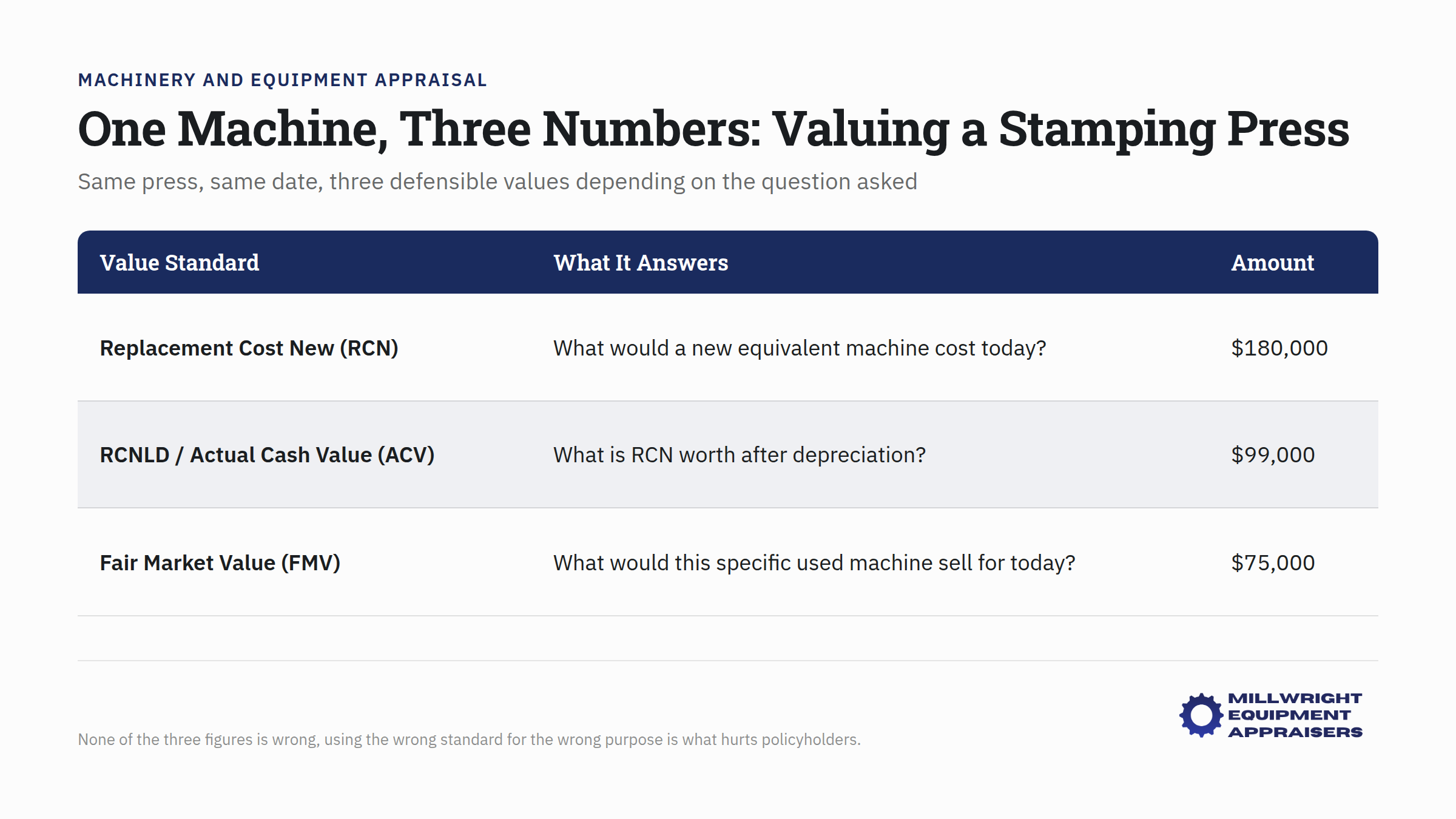
The stamping press example above produces three defensible but very different figures, and each one answers a different question:
| Value Standard | What It Answers | Amount |
|---|---|---|
| Replacement Cost New (RCN) | What would a new equivalent machine cost today? | $180,000 |
| RCNLD / Actual Cash Value (ACV) | What is RCN worth after depreciation? | $99,000 |
| Fair Market Value (FMV) | What would this specific used machine sell for today? | $75,000 |
All three numbers describe the same press on the same date. None of them is wrong; each reflects a different value premise, and using the wrong one for the wrong purpose is where policyholders get hurt.
Setting Coverage Limits vs Settling a Claim: Why the Standard You Use Matters
This is where the three standards create real financial consequences, in two opposite directions.
Underinsuring by using fair market value as a coverage limit. If a business insures its stamping press for $75,000 (the fair market value) rather than the $180,000 it would actually cost to replace it new, a total loss leaves a $105,000 gap between the payout and the cost of a working replacement. Coinsurance clauses in many commercial property policies can compound this problem further, reducing the payout proportionally when the insured limit falls below the required percentage of replacement cost.
Being surprised by a lower-than-expected ACV settlement. A policyholder who assumes their equipment is covered at full replacement cost, but who actually holds an ACV policy, will receive $99,000 rather than $180,000 after a total loss on the press in our example. That's a $81,000 shortfall relative to what it actually costs to buy a new equivalent machine, and it typically surfaces only after a loss has already occurred, when there's no time left to renegotiate coverage.
Key takeaway: Coverage limits should generally be set using replacement cost new, and claim expectations should be checked against the specific settlement basis (RCV or ACV) written into the policy, not assumed from memory or from the coverage limit alone.
How to Get the Right Value for the Right Purpose
An independent equipment appraisal gives insurers, brokers, and policyholders a documented, defensible figure tied to the correct value premise, whether that's RCN for setting a coverage limit, RCNLD/ACV for a claim settlement, or fair market value for a separate purpose like a sale, loan, or dispute. Our appraisers hold credentials with organizations including the ASA, CAGA, and NEBB, and every report is prepared in accordance with USPAP, so the conclusion holds up to scrutiny from adjusters, underwriters, and courts alike.
Equipment appraisal engagements for insurance purposes are quoted as a fixed fee determined by the scope of the assignment: the number and complexity of assets, the completeness of existing records, and the depth of analysis required. For machinery and equipment, standard reporting typically starts at $295 and IRS-qualified reporting at $395, with most engagements running $695 to $3,000 depending on scope; larger or highly complex fleets can run higher. Fees are never based on the value of the equipment itself, only on the scope of the work.
If you're insuring heavy machinery or a mixed fleet and aren't sure which value standard your policy is built on, our heavy machinery appraisal team can review the equipment and produce a report calibrated to the standard your insurer or broker actually requires, before a loss forces the question.
This article is provided for general informational purposes only and does not constitute legal, tax, or financial advice. Readers should consult a qualified insurance professional or attorney regarding their specific policy language and coverage.