
Blog
Why Your MACRS Depreciation Schedule Won't Match Your Equipment's Appraised Value
A MACRS depreciation schedule and an appraiser's fair market value conclusion answer two different questions and rarely land on the same number. This guide explains why, and when a business needs an independent equipment appraisal instead of a number pulled from the books.
A piece of machinery can show a book value of $0 on your depreciation schedule and still sell for $80,000 at auction next week. It can also show $200,000 of remaining tax basis and be worth a fraction of that on the open market. Neither outcome means the accounting is wrong. It means depreciation schedules and appraised value are built to answer different questions, and confusing the two can cost real money in a financing deal, an insurance claim, or a courtroom. Our machinery and equipment appraisal team gets asked to reconcile this gap constantly, so it's worth walking through exactly how the two numbers diverge.
What MACRS Actually Measures
MACRS, the Modified Accelerated Cost Recovery System, is a statutory formula for recovering an asset's cost on a tax return. It is not a valuation method, and it was never designed to estimate what a buyer would pay for the equipment today.
For property placed in service after 1986, the IRS generally requires MACRS to compute the depreciation deduction on a business return. The system assigns each asset to a property class, which fixes its recovery period, and then applies a prescribed method (commonly 200% declining balance switching to straight-line) along with a timing convention such as half-year or mid-quarter. None of those inputs reference the asset's condition, its remaining useful life, or what similar equipment is actually trading for in the secondary market. For a closer look at how these schedules are built, see our guide on what a depreciation schedule actually shows.
Typical Recovery Periods for Equipment
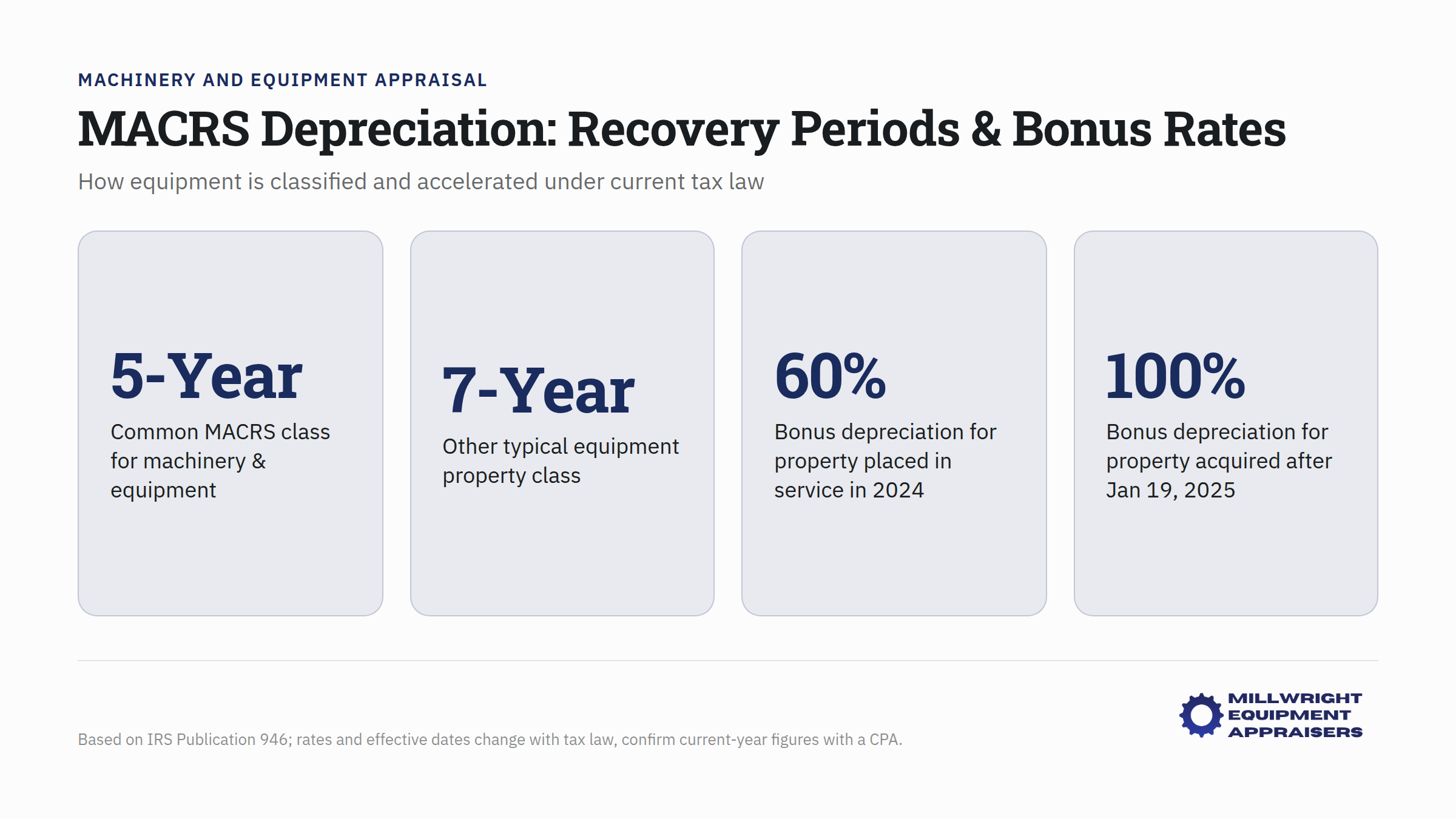
Most machinery and equipment falls into 5-year or 7-year property under MACRS, per IRS Publication 946, though the exact class depends on the asset type and its use. Bonus depreciation under Section 168(k) can accelerate that further: the deduction ran at 60% for property placed in service in 2024, was on a phase-down path toward 40% under prior law, and recent legislation restored 100% bonus depreciation for qualified property acquired after January 19, 2025. Rates and effective dates shift with tax law, so confirm the current-year figure with a CPA or the current edition of IRS Publication 946 before relying on it.
Why a Fully Depreciated Asset Can Still Carry Real Market Value
A machine with a $0 book value under MACRS can still have significant fair market value, because tax depreciation and economic depreciation are not the same measurement. MACRS pushes an asset's basis to zero on a fixed schedule regardless of how the equipment is actually holding up in the field.
Consider a CNC machine purchased 10 years ago and fully written off years ago on the depreciation schedule. If it has been well maintained, still runs to spec, and there's active demand for that model in the used market, an appraiser applying the sales comparison approach can support a meaningful value based on recent comparable sales. The tax schedule has nothing left to say about that machine; the market still does.
Key takeaway: a zero book value tells you the asset is fully expensed for tax purposes. It tells you nothing about whether the equipment still has utility, and utility is what drives market value.
Why High Remaining Basis Doesn't Guarantee High Value
The reverse problem shows up just as often. An asset can carry a large remaining tax basis, especially before bonus depreciation or Section 179 is applied, and still be worth less than that basis on the open market.
This happens through obsolescence, which appraisers separate into a few distinct categories:
- Physical deterioration: wear, damage, or heavy use that shortens remaining service life beyond what a generic depreciation table assumes.
- Functional obsolescence: the equipment still runs, but a newer model does the same job faster, cheaper, or with less labor, which drags down what buyers will pay for the older version.
- Economic obsolescence: external factors, like a shift in the industry the equipment serves or new regulatory requirements, that reduce demand for the asset class as a whole regardless of its condition.
Example: A specialty printing press with $150,000 of remaining tax basis might appraise at $40,000 if the print run lengths the industry needs have shrunk and buyers have moved to digital alternatives. The tax basis reflects an accounting formula applied at purchase; the appraised value reflects what the market will actually pay today.
How Appraisers Reach an Independent Value Conclusion
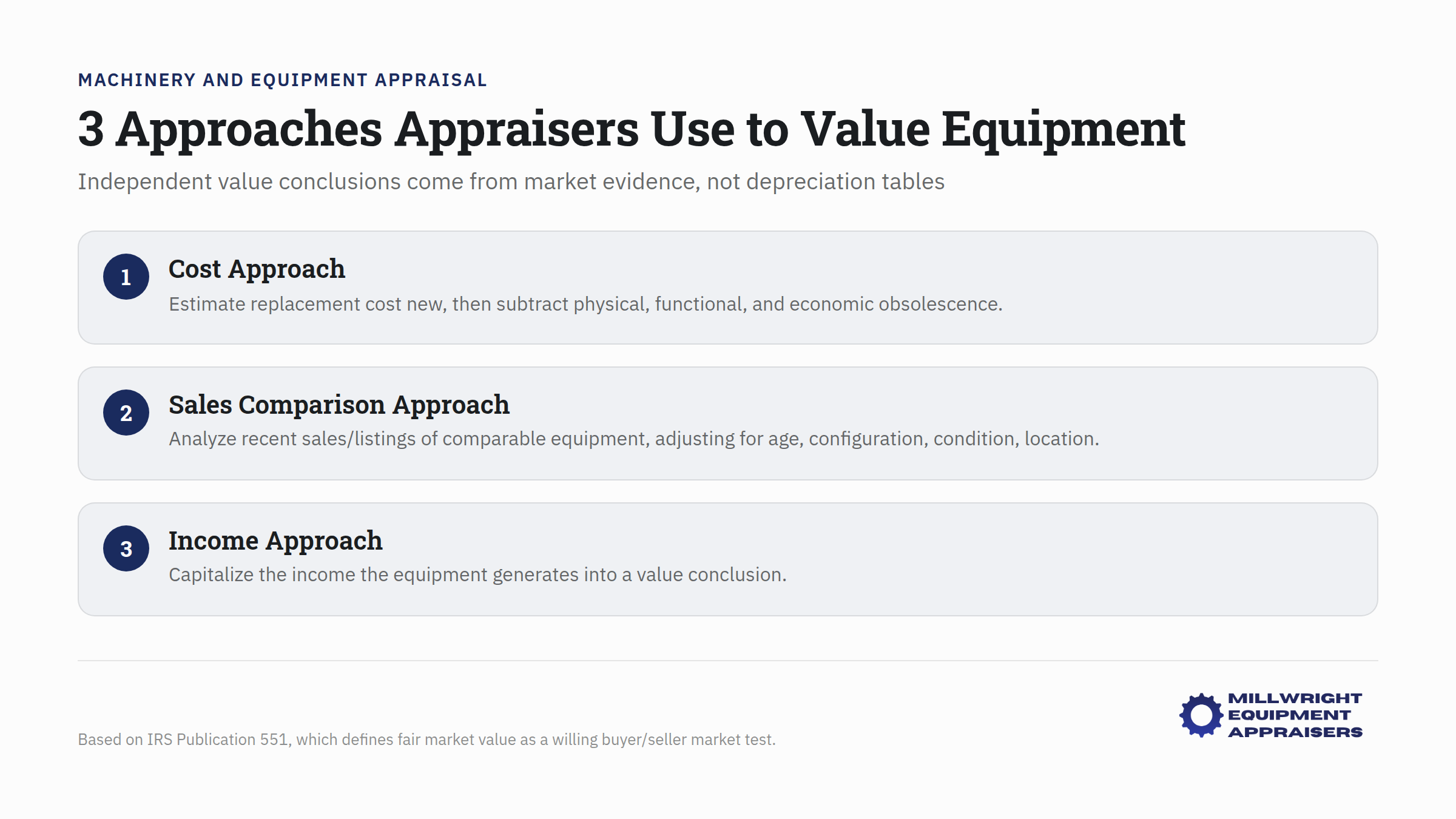
An appraiser's conclusion of fair market value or orderly liquidation value comes from market evidence, not from a depreciation table. IRS Publication 551 defines fair market value as the price at which property would change hands between a willing buyer and seller, neither under compulsion, both reasonably informed, which is a market test rather than a formula.
Depending on the asset and the assignment, our appraisers apply one or more of three recognized approaches:
- Cost Approach
- Estimate the replacement cost new of equivalent equipment, then subtract physical, functional, and economic obsolescence to reach an indicated value.
- Sales Comparison Approach
- Analyze recent sales or listings of comparable equipment, adjusting for differences in age, configuration, condition, and location.
- Income Approach
- Where the equipment's value is tied to the income it generates, capitalize that income stream into a value conclusion.
A depreciation schedule may be reviewed as background information, useful for confirming a placed-in-service date or an owner's internal asset tracking, but it is never substituted for this analysis. That distinction matters for anyone comparing our fair market value versus orderly liquidation value conclusions against what shows up on a balance sheet.
When You Need an Independent Appraisal Instead of Your Depreciation Schedule
A depreciation schedule works fine for filing taxes. It stops being sufficient the moment a third party needs a defensible, market-based opinion of value. That happens in several recurring situations:
- Financing and SBA collateral: Lenders need to know what the equipment could actually sell for if a loan goes into default, which is why a lender-facing appraisal supports an equipment appraisal for asset-based lending engagement rather than a book-value printout.
- Insurance coverage or claims: Replacement cost and fair market value diverge from tax basis in ways that directly affect what a claim should pay out.
- Litigation and partnership dissolution: When former partners or spouses disagree over what shared equipment is worth, a book value derived from an accelerated tax schedule rarely holds up as evidence.
- Estate and gift reporting: The IRS expects a supportable fair market value conclusion, not a depreciated tax basis, when equipment passes through an estate or a gift.
- Property tax appeals: Local assessors sometimes lean on depreciation schedules that no longer reflect an asset's real condition or market demand, and an independent appraisal gives a business grounds to contest that.
Engagements for machinery and equipment appraisals are quoted as a fixed fee after we scope the assignment, based on the number of assets, the complexity of the equipment, and whether the report needs to meet IRS-qualified standards or a standard reporting format. Fees are never billed hourly, and they are never driven by the asset's condition or market value itself. Businesses managing a larger, more complex fleet often start with our heavy machinery appraisal services to scope multi-asset engagements properly from the outset.
The Bottom Line on Book Value and Appraised Value
A MACRS schedule and an appraised value conclusion are both correct answers to different questions. The schedule tells the IRS how much of an asset's cost has been recovered this year. The appraisal tells a lender, an insurer, a court, or an estate what the equipment is actually worth in the market today. Treating one as a stand-in for the other is where businesses run into trouble, whether that means underinsuring a fully depreciated asset or overstating collateral value on a loan application.
When the number matters to someone outside your accounting department, it's worth getting an independent opinion built on market evidence rather than a tax formula.
This article is provided for general informational purposes only and does not constitute legal, tax, or financial advice. Readers should consult a qualified attorney or CPA regarding their specific circumstances.