
Blog
A Machinery and Equipment Appraisal Definitions Glossary Every Owner Should Know
Every machinery and equipment appraisal rests on precise appraisal definitions, and misreading one can shift the concluded value by tens of thousands of dollars. This glossary defines fair market value, the liquidation premises, depreciation, and the USPAP terms that shape every equipment appraisal report.
Ask two people what a piece of machinery is "worth" and you will likely get two different numbers, and both can be correct. The gap almost always comes down to appraisal definitions: which value premise applies, who the report is for, and what standard governs the work. This glossary walks through the terminology our appraisers use on every machinery and equipment engagement, from fair market value through depreciation, so you know exactly what a term means before you see it in a report.
What Is Fair Market Value in Equipment Appraisal?
Fair market value is the hypothetical price at which a piece of equipment would change hands between a willing buyer and a willing seller, with neither party under compulsion to act and both having reasonable knowledge of relevant facts. It is an opinion, not a transaction record. The asset does not actually need to sell for the value to apply.
For equipment, fair market value assumes a reasonable period of market exposure, the kind of timeline a seller would accept without being forced into a quick sale. It is the value premise most often used for donations, estate filings, and equitable distribution because it reflects a normal market, not a distressed one. Our what is fair value of machinery? FAQ walks through how this premise is calculated in more detail.
Example: A five-year-old CNC lathe with routine maintenance records and steady demand among machine shops might carry a fair market value of $85,000, reflecting what a reasonably informed buyer would pay without time pressure on either side.
What Is Orderly Liquidation Value?
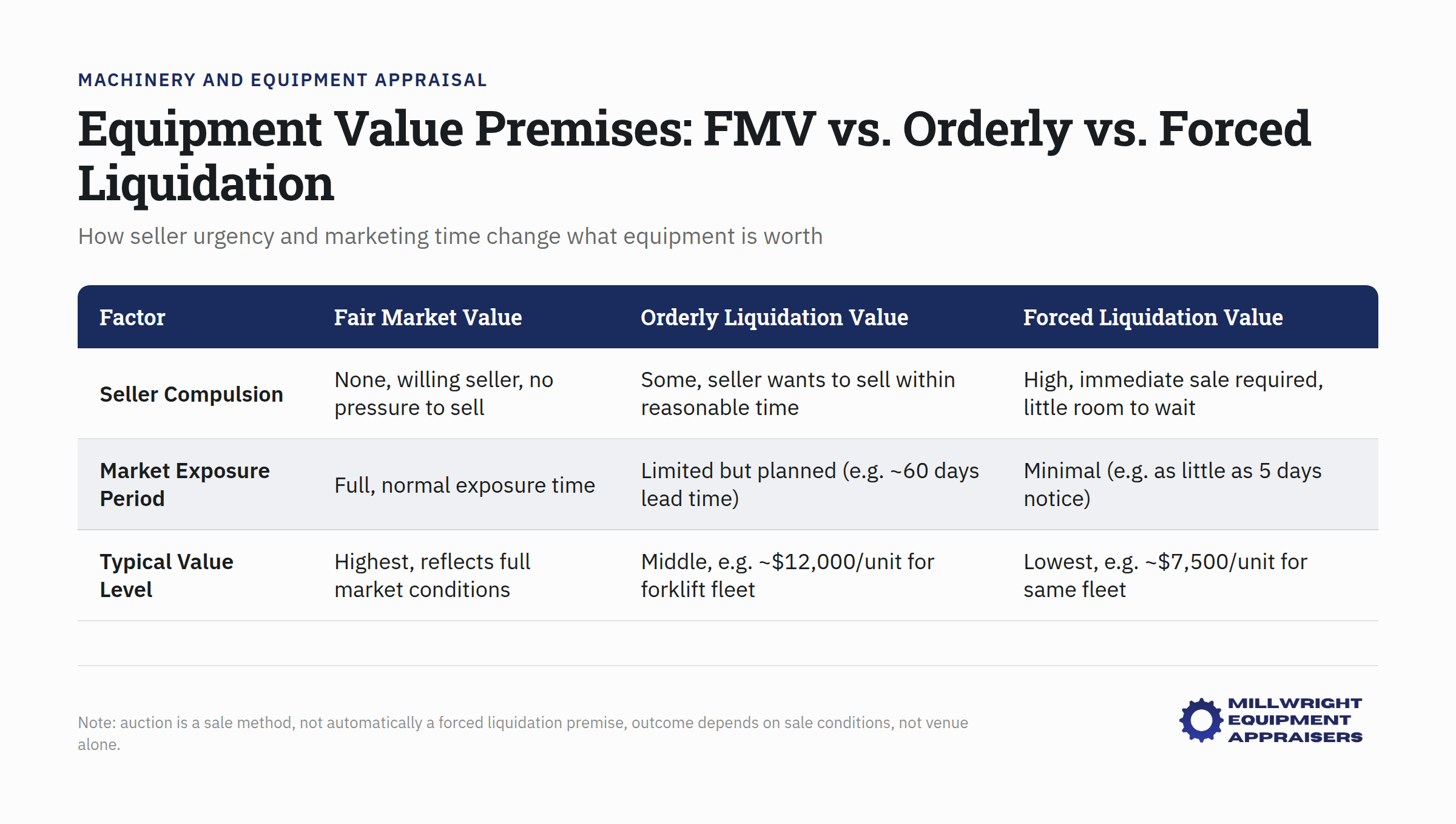
Orderly liquidation value estimates the price a piece of equipment would bring when the seller is compelled to sell, but the sale still gets a reasonable, limited period of market exposure, such as a well-advertised auction or consignment sale. The seller is under pressure; the marketing process is not rushed.
This premise sits below fair market value because compulsion narrows the buyer pool and shortens negotiating leverage, even when the sale is properly advertised. Lenders frequently request orderly liquidation value on collateral because it estimates recovery under a realistic, managed wind-down rather than a best-case sale. Our Fair Market Value vs Orderly Liquidation Value vs Forced Liquidation Value guide breaks down how appraisers choose between the three liquidation-related premises for a given assignment.
What Is Forced Liquidation Value?
Forced liquidation value estimates the price equipment would bring in an immediate sale, typically at auction, where urgency drives the transaction and marketing time is minimal. It is generally the lowest of the standard value premises because buyers know the seller has little room to wait.
An auction, on its own, is a method of sale, not automatically a forced liquidation premise. A well-attended, properly advertised auction with strong buyer turnout can sometimes produce results closer to orderly liquidation value, or even fair market value, depending on how much lead time and promotion went into it. The premise depends on the conditions of the sale, not the venue alone.
Example: A fleet of forklifts sold with 60 days of advertised lead time might realize orderly liquidation value near $12,000 per unit, while the same fleet sold with a five-day notice at a distressed auction might realize forced liquidation value closer to $7,500 per unit.
What Is Replacement Cost New?
Replacement cost new is the current cost to acquire a new asset of equal utility to the equipment being appraised, measured as of the appraisal date, before any depreciation is applied. It is the starting point of the cost approach, one of the three methods appraisers use to reach an indication of value.
Replacement cost new does not require an identical make or model. A machine that has been discontinued can still be replaced conceptually with a current model offering the same function and output. From there, the appraiser deducts depreciation to move from a new-asset cost to the equipment's actual condition and utility.
Salvage Value vs Scrap Value: What Is the Difference?
Salvage value is the amount expected for a whole asset or a component retired from service but still usable elsewhere, as of a specific date. Scrap value is the amount realized when the same asset is sold only for its raw material content, with no expectation of further productive use.
The distinction matters because it changes who the buyer is. A retired conveyor system with salvage value might be purchased by another facility for parts or reinstallation. The same conveyor valued at scrap is priced purely for its steel content, stripped of any equipment identity. Our Salvage Value Equipment Appraisal service handles this premise for insurance total losses, casualty claims, and asset disposition planning.
Example: A damaged industrial press with usable motors and gearboxes might carry a salvage value of $9,000 to a buyer who wants those components, versus a scrap value of $1,400 based purely on its weight in recyclable metal.
What Is a Desktop Appraisal?
A desktop appraisal is completed without a physical, in-person inspection of the equipment, relying instead on photographs, asset lists, maintenance records, and other documentation the client supplies. It is a legitimate, USPAP-compliant assignment type when the intended use supports a limited scope of work.
Desktop appraisals are common for lower-dollar assets, preliminary valuations, or situations where equipment is inaccessible, such as machinery already shipped overseas or sealed inside a facility undergoing sale. The appraiser still applies the same value definitions and analytical rigor; the difference is the source of the underlying data, and that limitation is disclosed clearly in the report.
What Is USPAP?
USPAP, the Uniform Standards of Professional Appraisal Practice, is the generally accepted set of standards governing appraisal ethics, appraiser competency, and reporting requirements in the United States. It is published and maintained by The Appraisal Foundation and applies across appraisal disciplines, including machinery and equipment.
Every report our appraisers deliver is prepared in accordance with USPAP, which means the assignment identifies the intended use, the intended users, the scope of work, and the value definition before any conclusion is reached. Our appraisers hold credentials with organizations such as the ASA, CAGA, and NEBB (CMEA), all of which build their training on USPAP compliance as the baseline standard. These standards apply consistently across appraisal specialties, including machinery and technical assets, not just real estate.
What Is Intended Use in an Equipment Appraisal?
USPAP defines intended use as the use or uses of an appraiser's reported opinions and conclusions, as identified by the appraiser based on communication with the client at the time of the assignment. It answers the question: what is this value going to be used for?
Intended use is not a formality. It determines which value premise applies (fair market value for a donation, orderly liquidation value for a loan workout), how much inspection detail is required, and how the report must be structured. Getting intended use right at the outset is what shapes the scope of work for the entire assignment.
What Is an Intended User?
USPAP defines intended user as the client and any other party identified, by name or type, as a user of the appraisal report by the appraiser, based on communication with the client at the time of the assignment. Anyone not identified this way is not an intended user, even if they later see the report.
This distinction protects both the appraiser and the client. A lender, a court, or a tax authority named as an intended user during the engagement can rely on the report; a third party who obtains a copy later without being identified generally cannot. Guidance from ISA on who can and should be listed as an intended user under USPAP walks through common scenarios where this comes up.
What Is Appraisal Purpose?
Appraisal purpose is the underlying reason the client needs the value opinion, such as insurance coverage, financing, tax reporting, litigation, or a business divestiture. Purpose and intended use work together to point the appraiser toward the correct value definition and the right depth of analysis.
A machine shop selling equipment as part of a bankruptcy proceeding has a different purpose than the same shop insuring the equipment against fire loss, and the two assignments will land on different value premises even though the physical assets are identical. Clarifying purpose at the start of the engagement is what keeps the final report defensible for its intended reader.
How Does Depreciation Work in Equipment Appraisal?
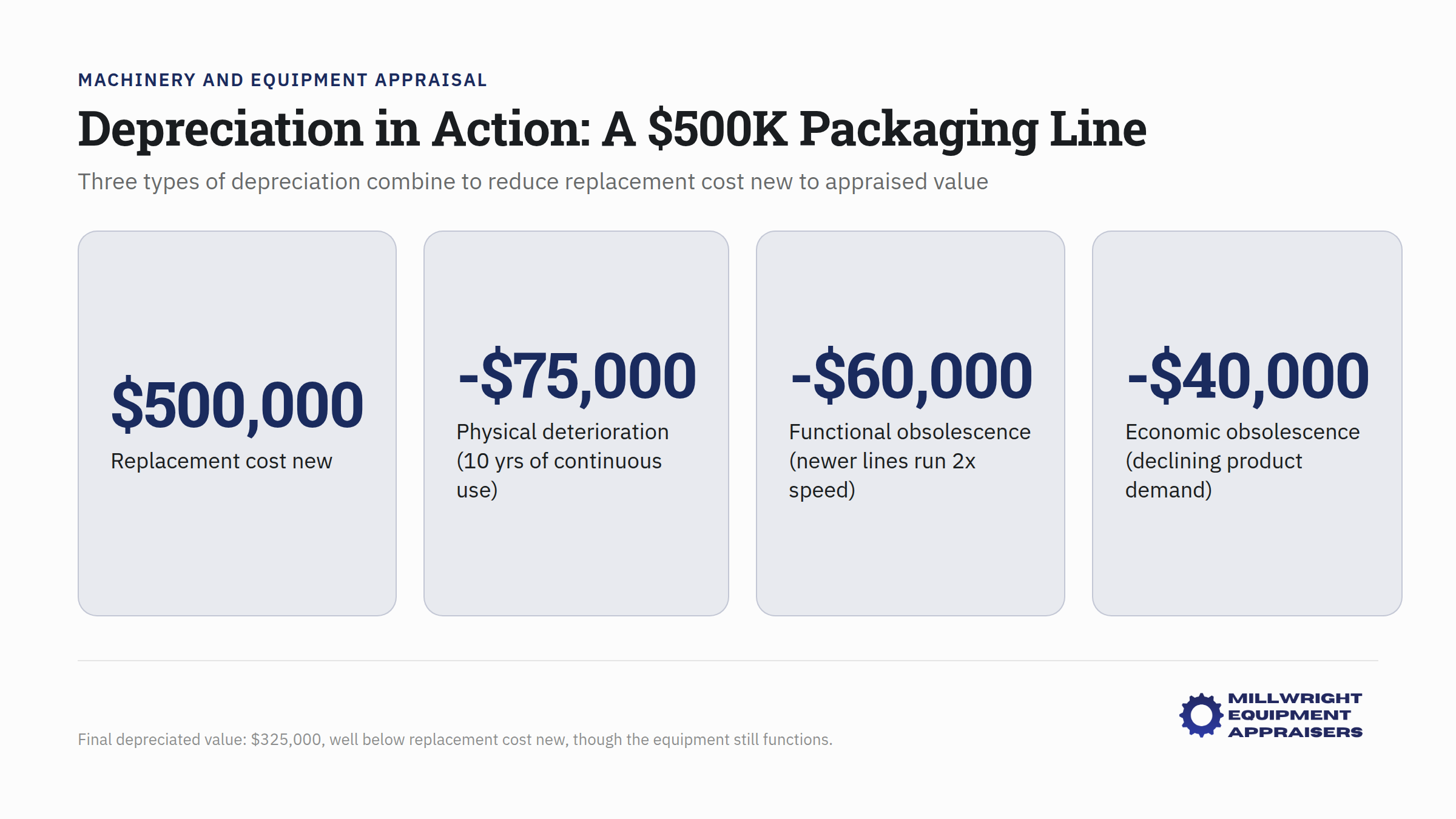
Depreciation is the loss in value between an asset's replacement cost new and its value as appraised, broken into three categories: physical, functional, and economic. Appraisers deduct each type separately because they come from different causes and behave differently over time.
- Physical deterioration reflects wear, age, hours of use, and maintenance history: the wear and tear you would see by walking up to the machine.
- Functional obsolescence reflects outdated design, capacity mismatches, or superseded technology, even when the machine still runs well mechanically.
- Economic obsolescence reflects external market forces, such as falling demand for what the equipment produces or new regulations, that have nothing to do with the machine's physical condition.
Example: A packaging line with a replacement cost new of $500,000 might lose $75,000 to physical deterioration from ten years of continuous operation, another $60,000 to functional obsolescence because newer lines run at twice the speed, and a further $40,000 to economic obsolescence tied to declining demand for the product it packages. That leaves a depreciated value of $325,000, well below replacement cost new even though the equipment still functions.
Scope of Work: Tying It All Together
Every machinery and equipment appraisal starts with the same chain of decisions: the client's appraisal purpose determines the intended use, the intended use identifies the intended users, and together those factors dictate which value definition applies and how much analysis the assignment requires. Skip any link in that chain and the report risks answering the wrong question.
Our appraisers walk through this chain on every engagement before an inspection is scheduled or a single value is calculated, whether the assignment calls for a full on-site review or a documented desktop appraisal. Getting the appraisal definitions right up front is what keeps the final number defensible for the reader who actually needs it.
If you need a USPAP-compliant machinery or equipment appraisal built around the correct value premise for your situation, our heavy machinery appraisal team can scope the assignment and quote a fixed fee before work begins.
This article is provided for general informational purposes only and does not constitute legal, tax, or financial advice. Readers should consult a qualified attorney or CPA regarding their specific circumstances.